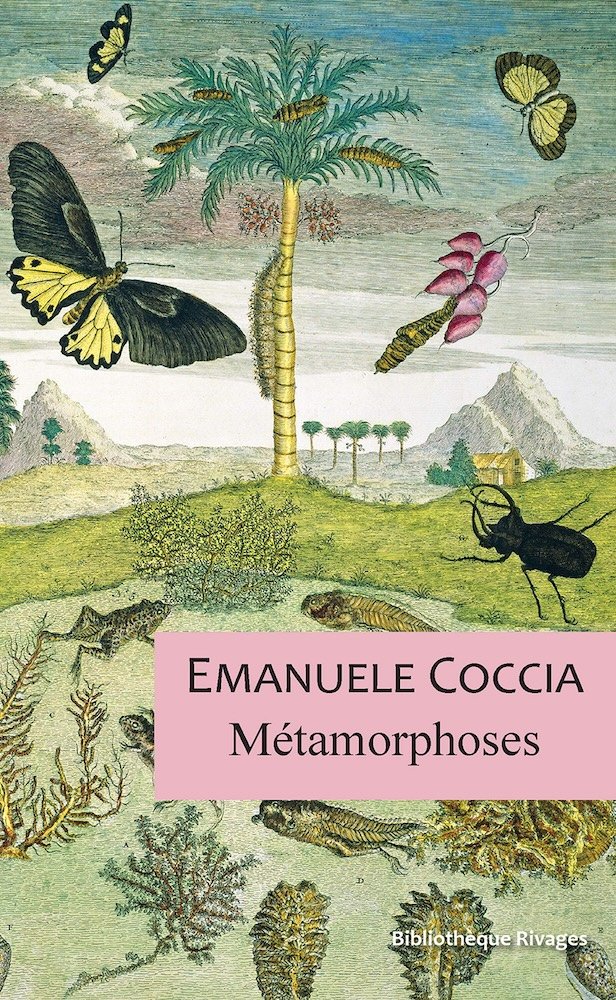
Invited to speculate on the future of Dutch landscapes through the Wonderkamer Theatre – a replica of Hieronymus Baron van Slingelandt’s miniature stage – I took Emanuele Coccia’s philosophy of metamorphosis along with me. This book, on the interconnectedness of matter and life forms, in constant transformation, has been a companion in my latest meditations on life in a planetary scale.
‘Het Wonderkamer Toneel’ project was conceived by Arne Hendriks and Josef Zappe, in collaboration with van Eesterenmuseum and Allard Pierson Museum; inviting five other artists to envision a scenographic transition for a replica of Slingelandt’s theater: Ludmila Rodrigues, Iskra Vuksic, Aurélien Lepetit, Justyna Chmielewska and Lucas Maassen. We presented our concepts between 6 November and 7 December 2025 at van Eesterenmuseum, in Amsterdam. Read more on: www.vaneesterenmuseum.nl/events/het-wonderkamer-toneel
‘the city fantasizing an outside self’
As an artist, trained as architect and urban planner, I don’t believe that landscapes exist without the human gaze and interference. This was my premise to look at the past and the present of the lowlands in order to imagine a way into the future. Given the density of the Dutch land use and the entanglement of urban and agricultural spaces, I approached the city as the multispecies cohabitation stage par excellence. Looking at the city as a landscape that is shared and built by many more species than the human, a place of constant transformation – as every species interacts and has an impact on the environment. Further, I embraced the notion of migration and the adaption of “invasive species” as a natural aspect of the environment’s metamorphosis, rather than assuming that there are stable qualities for species in relation to places.
According to Emanuele Coccia, “the ecosystem and the city are spaces of metamorphic conspiracy, whirlpools where forms combine to make possible a greater metamorphosis of the Earth – that is to pass on to Gaia a more intense and richer life.”
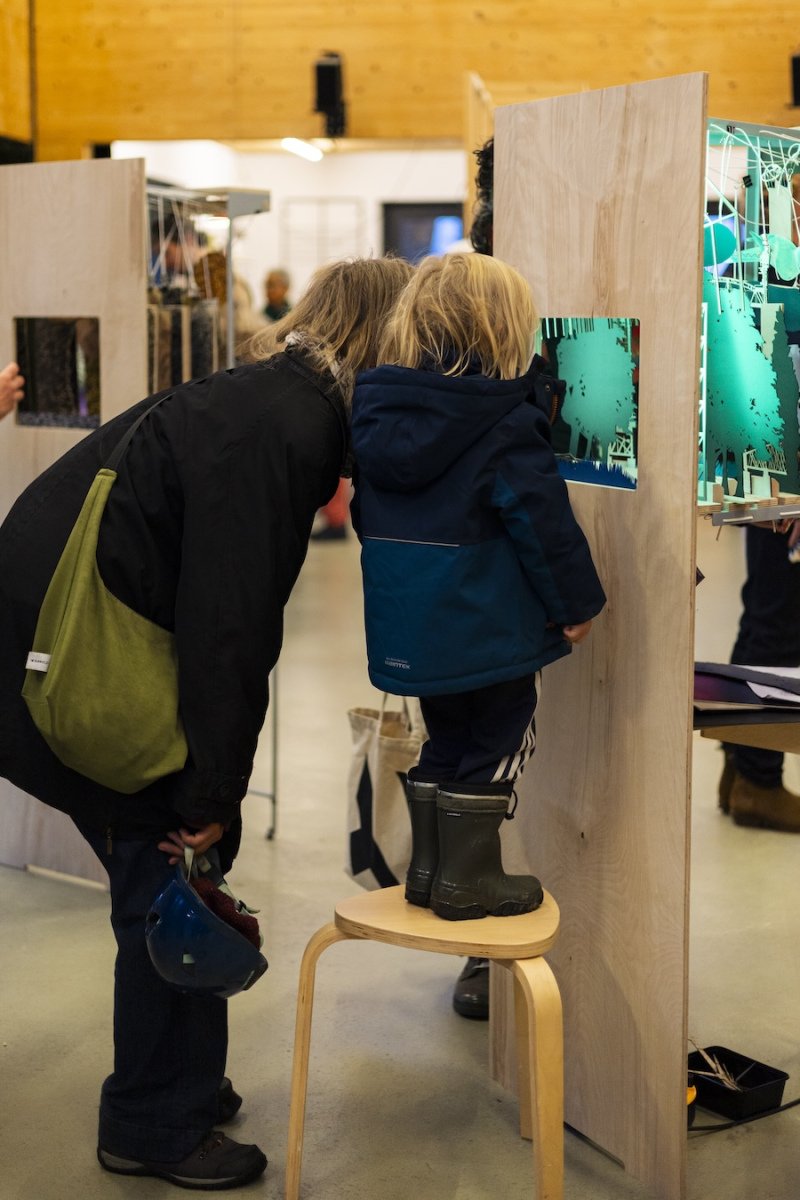
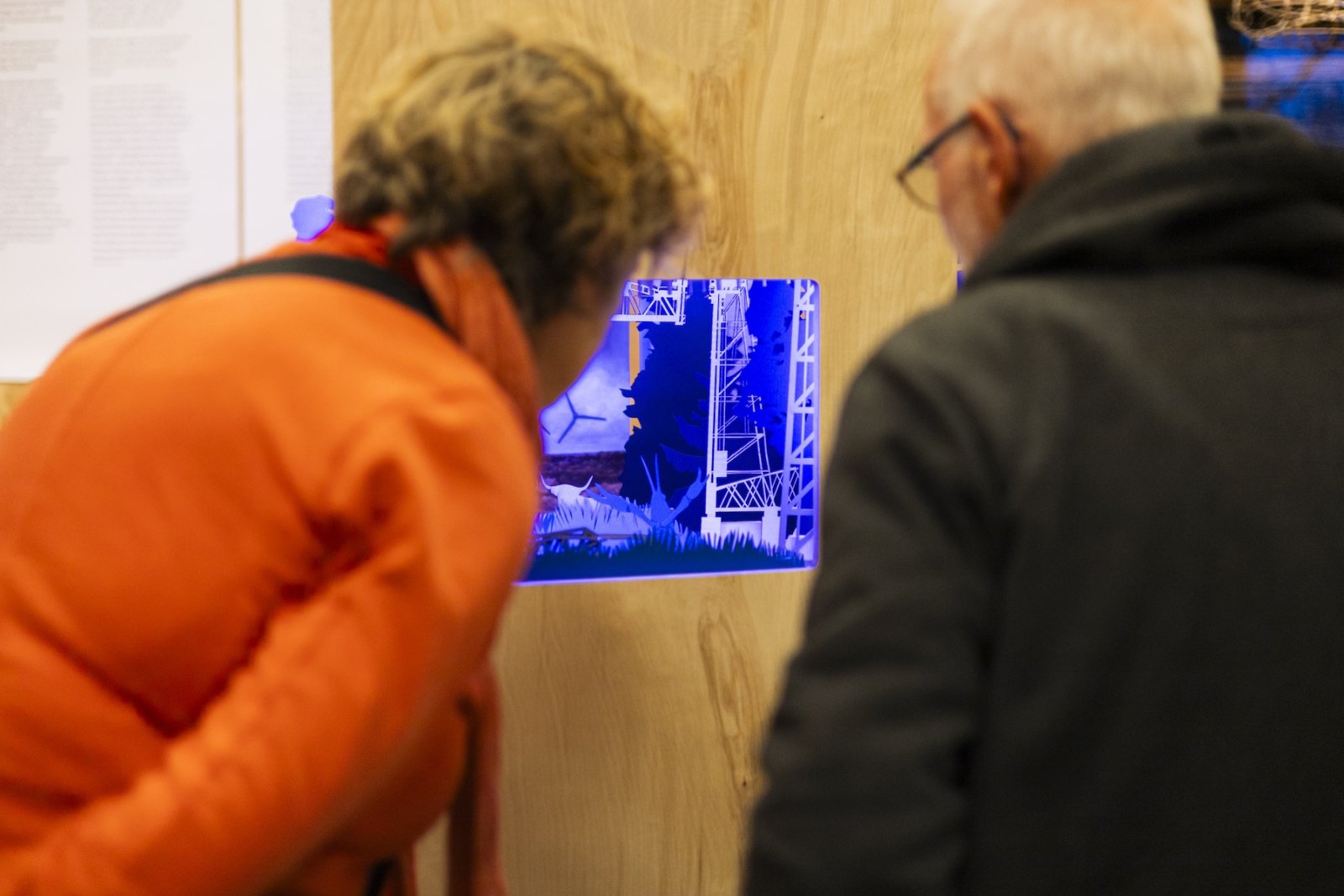

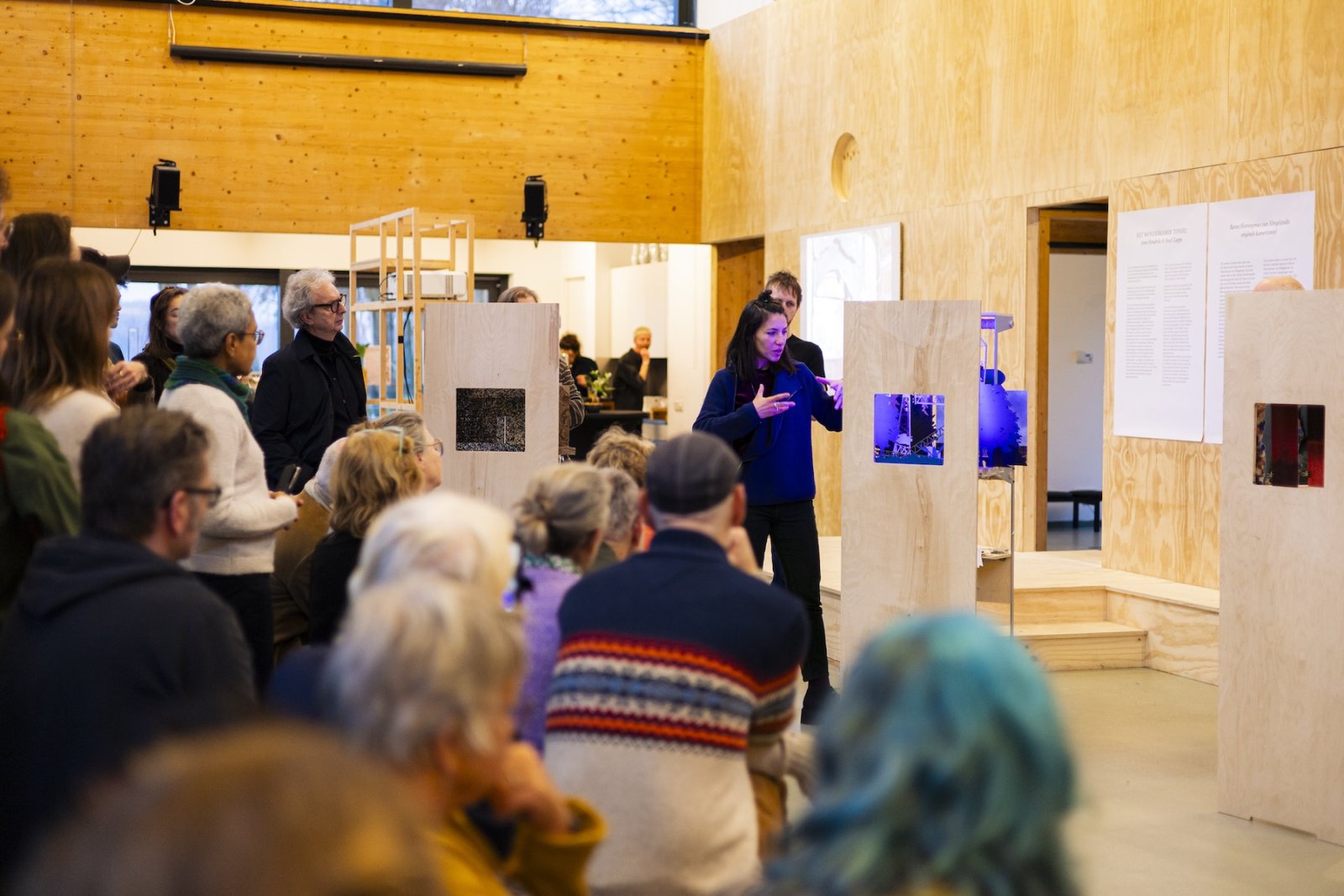
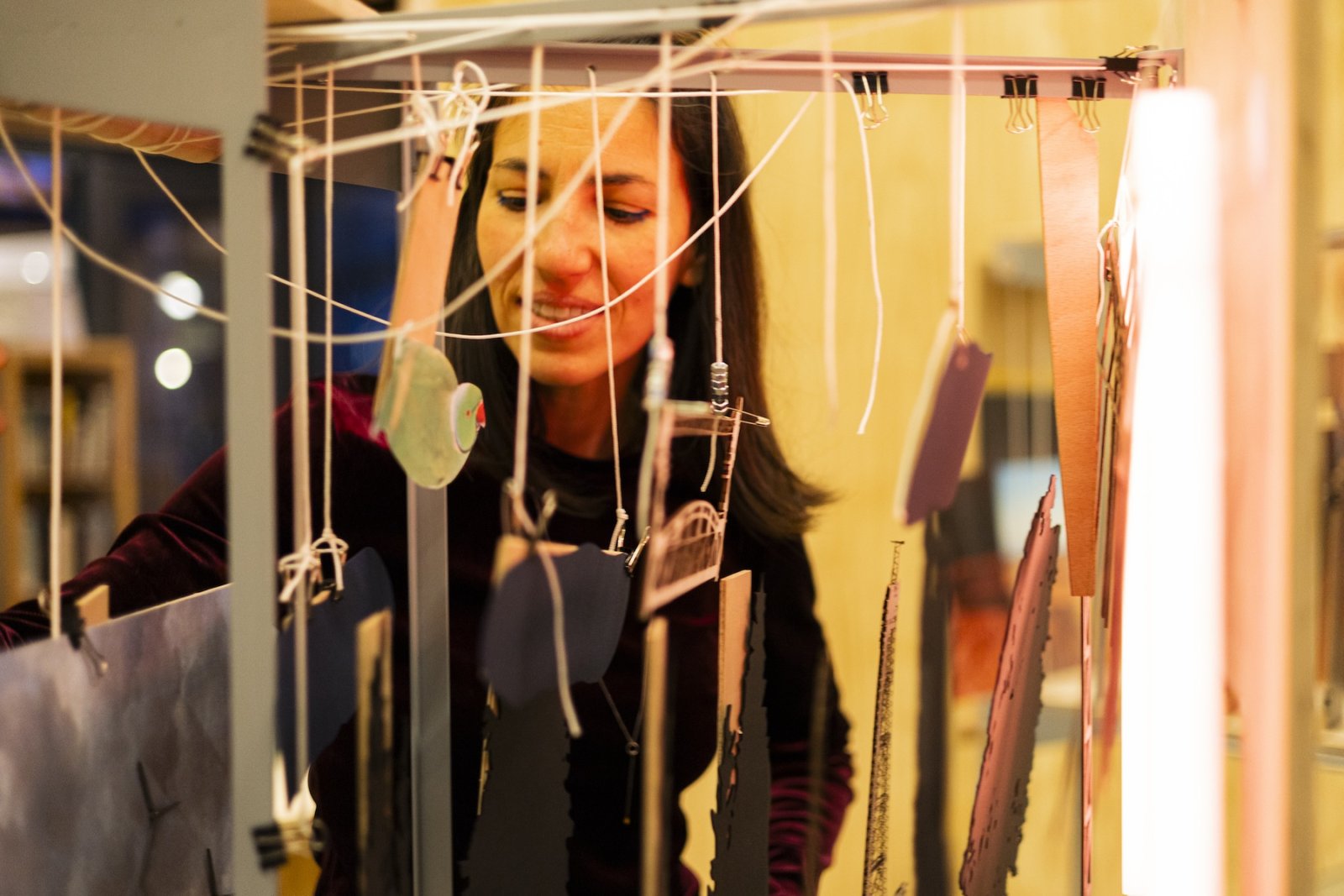
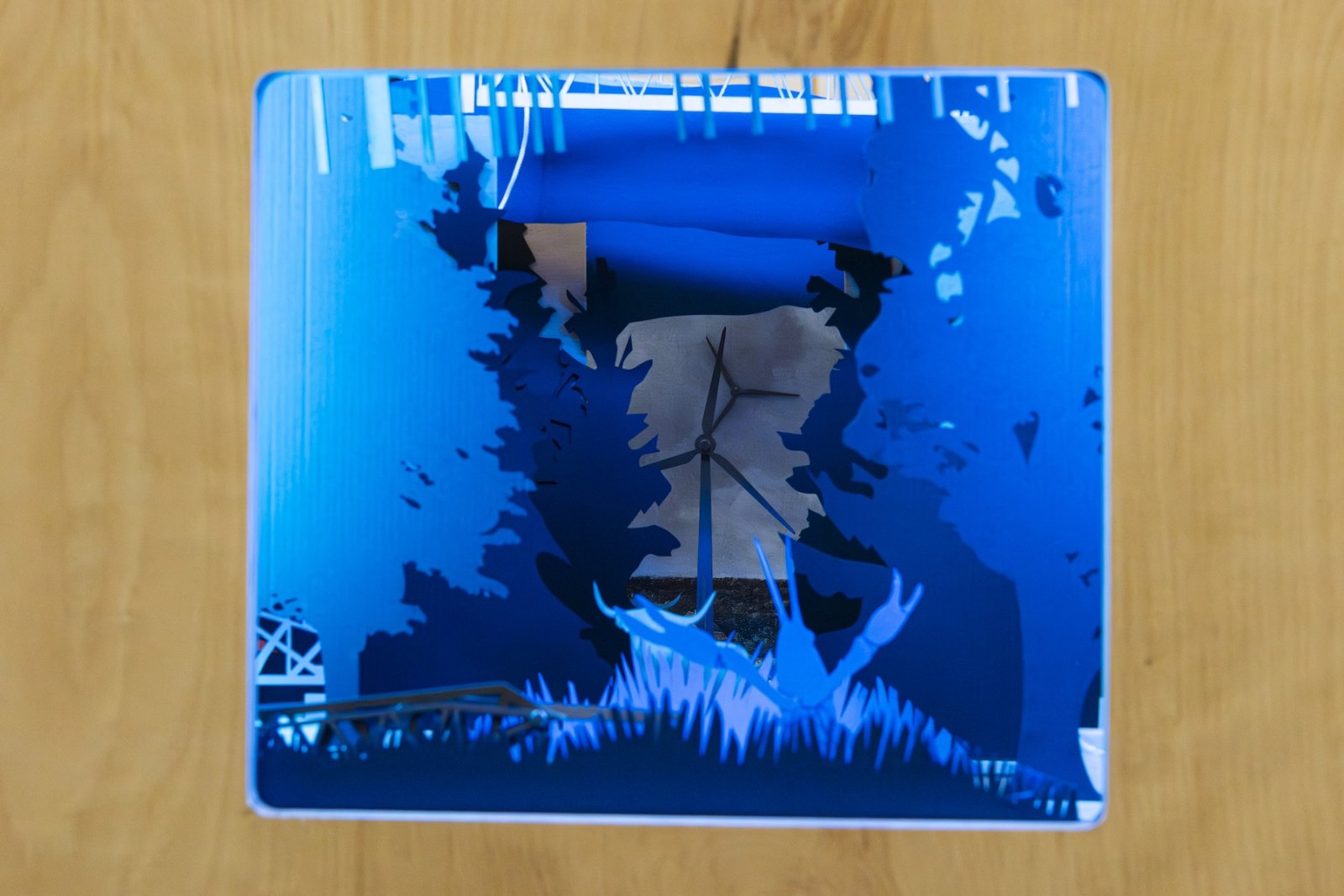

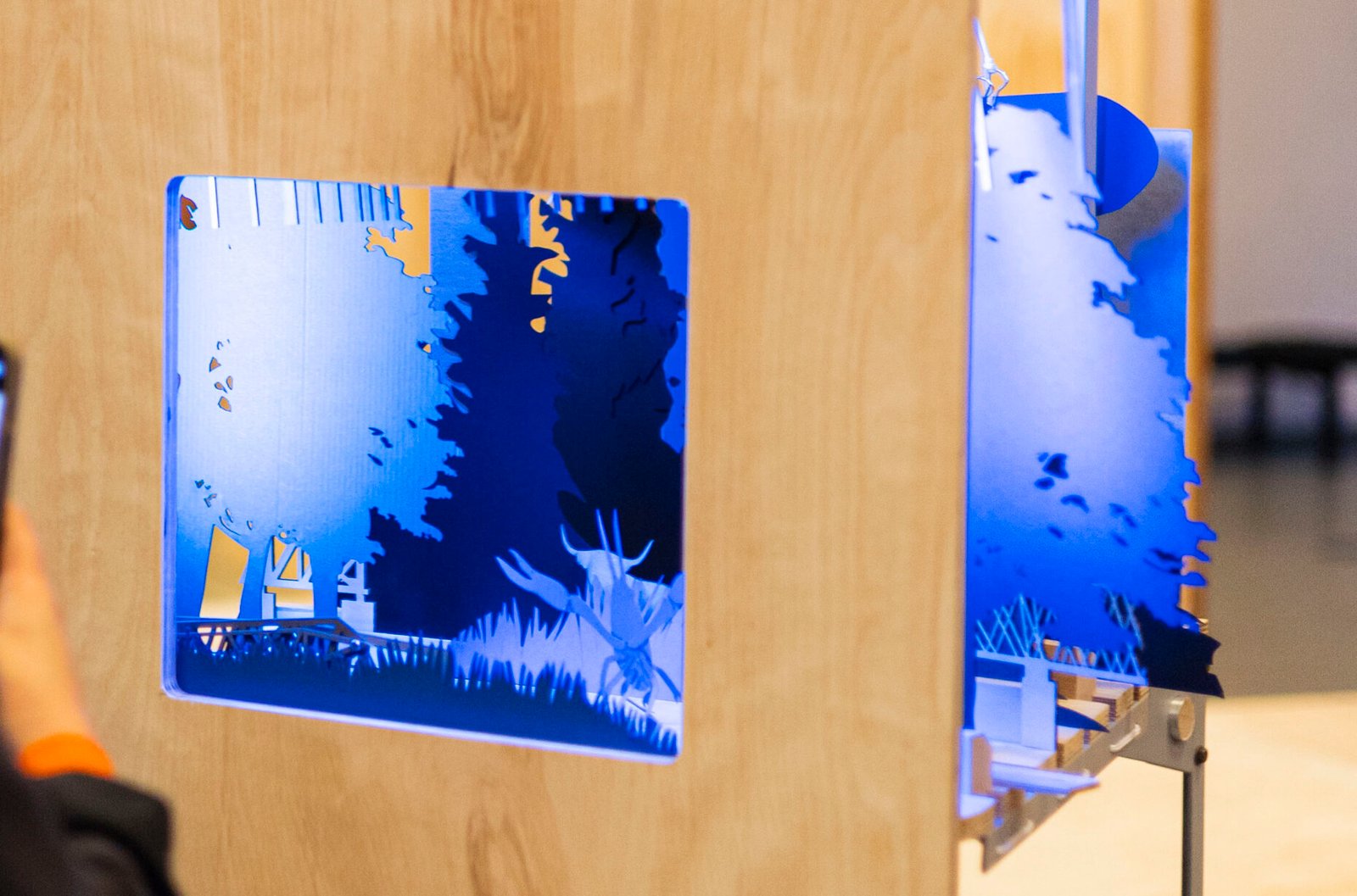
Presentation at van Eesterenmuseum, 7 December 2025 © Photos by Julia Catharina
I worked with different kinds of paper, by printing and laser cutting shapes to form a breathing stage, as an open space where life and movement seep through the theater’s boundaries. The images juxtapose classic paintings with contemporary Dutch infrastructural scenes (greenhouses, bridges, cranes, windmills) and with multiple animal species that share a degree of agency with humans in landscape design – including exotic ones, e.g. the oak processionary caterpillars (OPM, or Eikenprocessierups / eikenprocessievlinder /Thaumetopoea processionea), the Scottish Highland cattle, and the red swamp crayfish.
“We tend to think of the city as an entirely mineral, therefore monospecies space: as a collection of human beings, who live stably on a portion of Gaia‘s body, having manipulated the structure of this body to build their shelters. Everything that is neither mineral nor human — with very rare exceptions: cats, dogs, a few horses, ornamental plants, and, illegally and clandestinely, rats, and a few insects — is pushed back outside the city walls, into the forest— which already in its name (forest comes from the Latin word ‘foris’, ‘outside’) is defined by the situation of lack: lack of civilization, lack of humanity, lack of modernity, lack of technology. This opposition, which has guided the way in which we have imagined our coexistence in our politics, is both illusory and dangerous. It is illusory because the creation of an opposition between the city or civilization, and a so called “wild”, “natural” space is an entirely political myth. (…)
Emanuele Coccia Metamorphoses p. 149
This tendency is also dangerous, because a space made only of stones is technically the desert in the mineral fury of modern urbanism can only lead to the desertification of the planet. From this point of you, humanity, with its cities, seems to be the great Medusa of the planet. A mineral city operates in the opposite way to a forest. Every forest makes of life a force that allows the sunlight to collect in Gaia’s body to bring her life. For every plant, to grow used to accumulate light in its on body, to accumulate more and more light from an extraterrestrial star. Every plant is there for an agent, for the simulation of extraterrestrial stellar matter into the mineral body of Gaia. The tree, which we imagine is the most terrestrial expression of life, contains, and retains within its carbonic flash a light that comes from elsewhere. An apple, a pear, a potato: little extra terrestrial shards of light encapsulated in the mineral matter of our planet. It is the same light that each animal looks for in the body of the other, when it eats (no matter whether it eats plants or other animals): every act of feeding is nothing other than a secret and invisible exchange of extraterrestrial light, which, through these movements, flows from body to body, from species to species, from kingdom to kingdom. Living beings transform stones into stellar deposits”.
Baron van Slingelandt’s gorgeous miniature was built in 1781 to entertain a small group of guests at his own home in Amsterdam. The mechanical model was then based on the Amsterdam’s city theater, giving Slingelandt (1762-1829) the chance to experiment and prototype scenographic ideas for the real-life stage. Today the model is part of the Allard Pierson Museum collection, located in Amsterdam.
Arne Hendriks: “Just as people once literally pulled the strings of theatre decors, so today they influence the layout of our natural environment. We often see the landscape as a manufacturable machine.” Through this work, Hendriks welcomes visitors to come closer to the replica on days when the artist is present at Allard Pierson Museum and investigate with him the technique behind the transformation of the scenes. Read more on: www.allardpierson.nl
“A multispecies city is a transcendental form of relationship between all species – a relationship which enables the genesis of the world. For the genesis of the world is (…) not the emergence of a single species. There is no world in which there is only one form of life. The world is always the result of cosmic agriculture, or husbandry, of a metamorphic relationship between several species.” – Emanuele Coccia”
Not every exotic species that flourishes here is considered invasive. “Invasive means that a species causes a nuisance”, terrestrial ecologists say; species that cause allergic reactions are the major culprits, like, in recent years, giant hogweed, oak processionary caterpillar and common ragweed. In their new habitat, they are not eaten and they can therefore become overdominant.” (Source: the Netherlands Institute of Ecology, NIOO-KNAW)
With thanks to van Eesteren Museum.